The Marketing Automation Setup That Runs Your Business While You Sleep
What This Blog Covers
- Why marketing automation is the key to a business that runs 24/7
- How a complete automation setup actually works (lead capture, CRM, email, integrations, social, analytics)
- The real business benefits: recovered revenue, personalization at scale, shorter sales cycles, and time saved
- A step-by-step action plan to start building your own automation system today
Attention: What If Your Business Never Actually Stopped Working?
Picture this: it’s 2 a.m. You’re asleep. Your phone is on silent. And yet, right now, somewhere in the world, a potential customer is:
- Reading a welcome email your system sent the moment they subscribed
- Getting a personalized product recommendation based on what they browsed yesterday
- Receiving an SMS reminder about the cart they abandoned
- Being tagged as a “hot lead” in your CRM and queued for a follow-up call in the morning
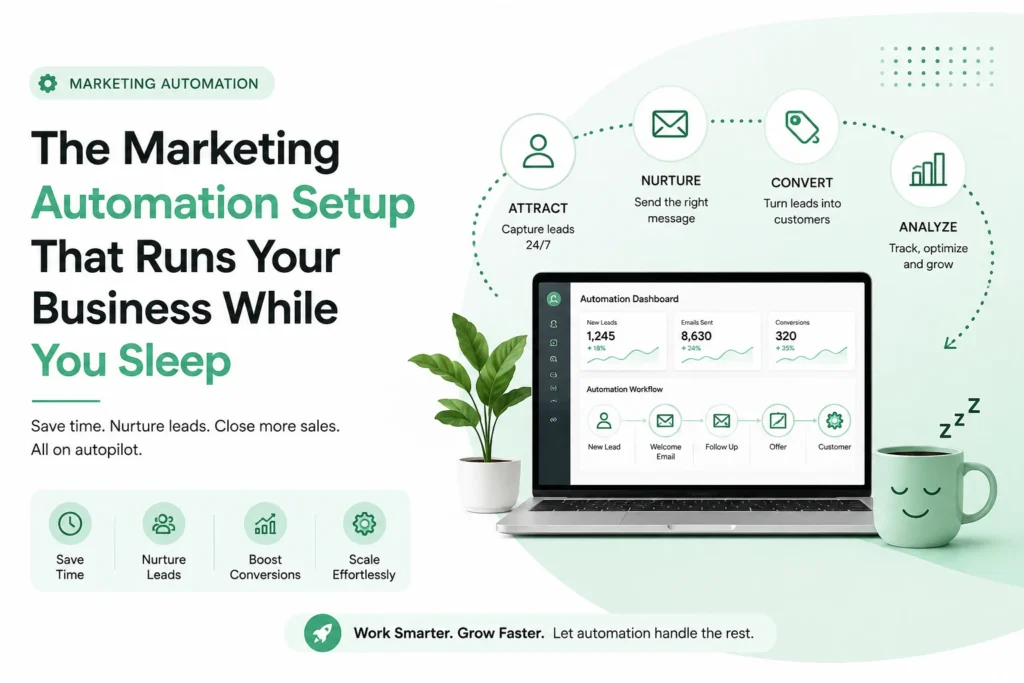
None of this required you to lift a finger. This is marketing automation — a connected system of software, workflows, and triggers that handles lead generation, nurturing, and even sales conversion without constant human input.
If you’re still manually sending follow-up emails, tracking leads in spreadsheets, or posting on social media in real time every single day, you’re not running a business — you’re running on a treadmill. And treadmills don’t scale.
The businesses pulling ahead in 2026 aren’t necessarily the ones working harder. They’re the ones who’ve built a marketing automation ecosystem that works around the clock, converting attention into revenue while the founder sleeps, travels, or focuses on strategy instead of repetitive tasks.
Interest: How a Marketing Automation Setup Actually Works
Marketing automation isn’t a single tool — it’s an interconnected stack. Think of it like a factory assembly line for customer relationships, where each station (or software) hands off the customer to the next step automatically.
Here’s what a complete, “sleep-proof” automation setup typically includes:
1. Lead Capture Layer
Tools like OptinMonster, Typeform, or embedded landing page forms built in HubSpot or ClickFunnels collect visitor information the moment someone shows interest — whether through a lead magnet, a quiz, or a newsletter signup.
2. CRM (Customer Relationship Management) System
Platforms such as HubSpot CRM, Salesforce, or Pipedrive act as the central nervous system. Every lead, every interaction, every email open gets logged automatically, giving you a real-time picture of where each prospect sits in the buyer journey.
3. Email Marketing Automation
Using Mailchimp, ActiveCampaign, or Klaviyo, you can build drip campaigns and behavioral email sequences that respond to what a user does — not just a fixed schedule. Someone downloads a guide? They get a 5-part nurture sequence. Someone abandons a cart? They get a reminder with a discount code 24 hours later.
4. Workflow & Integration Automation
This is the glue. Zapier, Make (formerly Integromat), or native integrations connect every tool so data flows seamlessly — a new lead in your form automatically becomes a contact in your CRM, triggers a welcome email, and notifies your sales team on Slack.
5. Social Media & Content Scheduling
Tools like Buffer, Later, or Hootsuite queue up weeks of content in advance, maintaining a consistent brand presence without daily manual posting.
6. Analytics & Reporting Dashboards
Google Analytics 4, along with built-in reporting from your CRM and email platform, tracks performance so you can see what’s converting — without manually pulling reports.
Each of these pieces functions like a gear in a larger machine. Individually, they’re useful. Connected together into one automated marketing funnel, they become a self-sustaining growth engine.
Desire: Why This Setup Changes Everything for Your Business
It’s easy to think of automation as a “nice to have.” But once you see what it actually replaces, it becomes hard to imagine running a business without it.
It Recovers Revenue You’re Currently Losing
Studies consistently show that abandoned cart emails alone can recover 10–15% of otherwise lost sales. Multiply that across every touchpoint — abandoned forms, unopened emails, cold leads — and automation isn’t a cost. It’s a revenue-recovery system.
It Delivers Personalization at Scale
Manually personalizing outreach for hundreds or thousands of leads is impossible. Automation platforms use behavioral triggers — page visits, purchase history, engagement scores — to deliver the right message to the right person at the right time, automatically.
It Shortens Your Sales Cycle
Lead scoring (built into tools like HubSpot and ActiveCampaign) automatically flags when a prospect is “sales-ready,” so your team spends time only on leads who are actually warm — not chasing cold contacts.
It Buys You Back Time
This is the real unlock. Business owners who implement full-funnel automation report saving 10–20 hours per week that used to go into manual follow-ups, social posting, and admin work. That’s time reinvested into product development, strategy, or simply having a life outside the business.
It Builds a System, Not a Dependency
A business that relies entirely on the founder’s daily hustle isn’t really a business — it’s a job. A properly automated marketing engine means the business generates leads and nurtures customers whether you’re working, on vacation, or asleep. That’s what makes a business genuinely scalable — and eventually, sellable.
Real-World Snapshot
E-commerce brands using automated email flows (welcome series, abandoned cart, post-purchase upsell) commonly see 25–30% of total email revenue coming from just those three automated flows — not from manually sent campaigns. That’s not a hypothetical. That’s the compounding value of a system built once and left running.
Action: How to Start Building Your Automation Setup Today
You don’t need a 20-tool stack on day one. Start lean, prove the system works, then expand.
Step 1: Map Your Customer Journey
Before touching any software, write out the path a lead takes — from first contact to purchase to repeat customer. This becomes the blueprint for your automation workflows.
Step 2: Choose One CRM as Your Hub
Pick a central CRM (HubSpot’s free tier is a strong starting point) and commit to it. Every other tool should connect back to this system.
Step 3: Build Three Core Email Sequences
Start with:
- A welcome sequence for new subscribers
- An abandoned cart or abandoned inquiry sequence
- A post-purchase or post-conversion follow-up sequence
Step 4: Connect Your Tools with Zapier or Native Integrations
Set up automated handoffs between your form, CRM, and email platform so no lead ever falls through the cracks manually.
Step 5: Schedule Content a Month in Advance
Use a scheduling tool to batch-create and queue social content, freeing up daily bandwidth.
Step 6: Review and Optimize Monthly
Automation isn’t “set and forget” forever — it’s “set, monitor, and refine.” Check open rates, conversion rates, and workflow performance monthly, and adjust triggers or messaging as needed.
The Bottom Line
A well-built marketing automation setup isn’t about replacing the human element of your business — it’s about removing the repetitive, time-draining tasks so you can focus on strategy, creativity, and growth. Once your CRM, email marketing automation, and workflow integrations are connected, your business stops depending on your constant presence to move forward.
That’s the real promise of automation: a business that keeps working, generating leads, and nurturing customers — even while you sleep.
Ready to build your own automation engine? Start with one workflow this week. Map it, connect it, and let it run. You’ll be surprised how quickly the system starts paying you back in time and revenue.
Need Help Setting This Up?
If you’d rather have an expert build this for you than piece it together yourself, feel free to reach out. As a freelance digital marketer based in Kuwait, I help businesses design and set up complete marketing automation systems — from CRM setup and email workflows to tool integrations and campaign automation — tailored to your business goals. For any enquiries about setting up your own automation system, get in touch and let’s build a setup that works for you around the clock. www.amaljithp.com