Table of Contents
- Introduction
- Why Google Algorithm Updates Matter for SEO
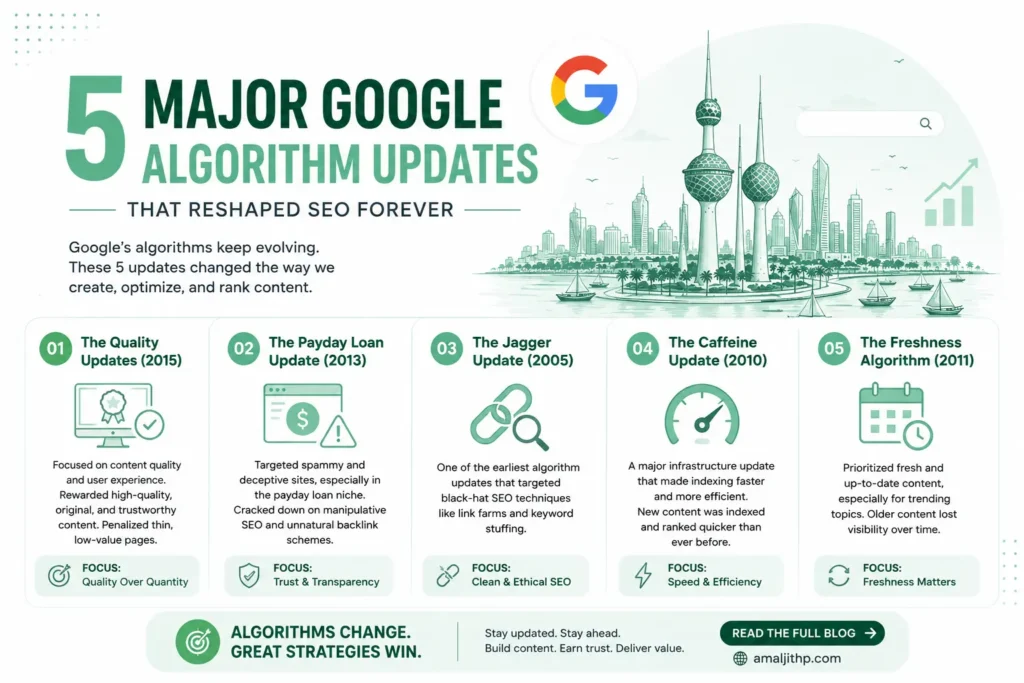
- The 5 Major Google Algorithm Updates That Changed SEO Forever
- 3.1 The Quality Updates (2015)
- 3.2 The Payday Loan Update (2013)
- 3.3 The Jagger Update (2005)
- 3.4 The Caffeine Update (2010)
- 3.5 The Freshness Algorithm (2011)
- Key Lessons from These Google Updates
- Frequently Asked Questions (FAQ)
- Conclusion
Since its founding, Google has rolled out thousands of changes to how it ranks web pages. Most go unnoticed by anyone outside the SEO industry, but a handful have been big enough to rewrite the rules of search overnight, forcing website owners, marketers, and entire industries to adapt or fall out of the rankings. These milestone updates offer a kind of timeline of what Google has valued most at each stage of its history: infrastructure stability, timely and relevant content, local intent, mobile usability, and beyond.
This post walks through five of the most influential Google algorithm updates — Big Daddy, the Freshness Algorithm, Venice, Mobilegeddon, and Pigeon — explaining what each one changed, why Google made the move, and what it meant for the sites caught in the crossfire.
1. Big Daddy (2005–2006): Rebuilding the Foundation
Long before “core update” was a common phrase in SEO circles, Google quietly began overhauling its own back-end infrastructure. Announced by Matt Cutts, then head of Google’s webspam team, in late 2005, Big Daddy wasn’t a single ranking-factor tweak — it was a wholesale rebuild of the technology powering search itself. Google tested the new infrastructure on a couple of dedicated servers, invited the SEO community to poke around and report back, and gradually rolled the new system out across all its data centers between January and March 2006.
The name itself came from an offhand suggestion at an industry conference, borrowed from a nickname one attendee’s kids had given him — a reminder that even Google’s biggest technical shifts sometimes got their names in casual, unscripted moments.
Because Big Daddy touched core plumbing rather than a single ranking signal, it got blamed (often incorrectly) for a lot of unrelated phenomena happening around the same time: sites landing in Google’s secondary “supplemental” index, the mysterious “sandbox” effect that seemed to hold back brand-new domains, and the older practice of watching results “dance” between data centers as they synced. Google was fairly open about testing canonicalization, redirect handling, and link-quality signals during this period, but it never gave a tidy, complete account of everything the new infrastructure changed. The lasting legacy of Big Daddy is less about a specific ranking boost and more about the precedent it set: Google could — and would — periodically rebuild its engine from the inside out.
2. The Freshness Algorithm (2011): Teaching Google to Value Timing
By 2011, Google had a new problem to solve: some searches genuinely need up-to-the-minute answers, while most don’t. The Freshness Algorithm, announced in early November 2011, gave Google a formal way to tell the difference — and it reportedly touched a meaningful share of all search queries, with a smaller but still significant slice seeing a noticeable shift in their results.
This update became possible thanks to the earlier Caffeine indexing overhaul, which let Google crawl and process the web at a much faster clip. With that infrastructure in place, Google identified three distinct situations where recency should factor into rankings: breaking news and trending topics, recurring events that happen on a predictable schedule (think elections, awards shows, or sports seasons), and subjects that get updated frequently even without being “newsy,” like reviews of the latest phone model.
It’s worth noting the Freshness Algorithm wasn’t Google’s first attempt at this problem — a narrower concept called “Query Deserves Freshness” had existed since 2007, aimed mainly at spotting when a topic was suddenly hot across news and blogs. The 2011 update was more structured and far more capable, thanks to the faster indexing pipeline behind it.
One persistent myth this update helped create — and which Google has since had to repeatedly debunk — is the idea that simply updating a page’s date stamp, even without meaningfully changing the content, will boost rankings. Google has been clear for years that freshness only matters for queries that actually call for it; evergreen topics like a classic recipe or a how-to guide don’t get any benefit from an artificially bumped publish date.
3. Venice (2012): Local Results Enter the Mainstream
For years, “local search” and “regular search” behaved like two separate products. If you wanted nearby businesses, you’d lean on Google Places; the standard results — the classic ten blue links — largely ignored where you were searching from.
Venice, mentioned briefly as one of roughly 40 changes Google disclosed in a February 2012 search-quality update, closed that gap. After Venice, ordinary organic results started reflecting a searcher’s location even for queries that didn’t explicitly mention a place, as long as Google’s systems detected local intent. A search for a service or product type could now surface nearby businesses directly in the main results, not just in a separate local box.
This was a genuine opportunity for smaller and independent businesses. Suddenly, a well-optimized local landing page could compete for broader, higher-volume keywords that used to be the exclusive territory of big national brands with deep SEO budgets. Of course, wherever there’s opportunity, there’s also incentive to cheat the system — Venice also coincided with an uptick in local SEO spam tactics, such as stuffing pages with long lists of nearby town names or building thin “doorway” pages for every service area. Google’s fight against those tactics has continued in local search algorithms ever since, but Venice is generally seen as the moment “near me”-style relevance became a permanent, foundational part of how Google ranks everyday searches.
4. Mobilegeddon (2015): The Mobile-First Ultimatum
By 2015, mobile browsing had overtaken desktop for a huge share of searches, and Google decided it was time to make mobile-friendliness a hard requirement rather than a nice-to-have. On April 21, 2015, Google’s mobile-friendly update went live, and unlike most algorithm changes, this one came with fair warning — Google had announced the coming change roughly two months in advance and given webmasters a clear yes-or-no test to check whether their pages qualified.
The update was refreshingly simple by algorithm-update standards: a page was either mobile-friendly or it wasn’t, and non-mobile-friendly pages lost ground specifically in mobile search rankings (desktop rankings were untouched). Despite dramatic nicknames — “Mobilegeddon” chief among them — the real-world ranking disruption turned out to be fairly modest. Analysts tracking search volatility during the rollout found only a mild bump in ranking “temperature,” and some pointed out that page speed seemed to matter just as much as strict mobile-friendliness.
What made Mobilegeddon important wasn’t the size of the ranking shake-up; it was the cultural shift it triggered. Google dangled a ranking incentive, gave the industry time to prepare, and successfully pushed a huge number of sites to invest in responsive, mobile-ready design — well ahead of the eventual move to mobile-first indexing. A follow-up strengthening of the same signal arrived about a year later in 2016, reinforcing the message without causing a second wave of panic. In hindsight, Mobilegeddon may be one of Google’s smoothest-run major updates, precisely because it gave site owners a fair runway to adapt.
5. Pigeon (2014): Local Search Gets an Organic Overhaul
Launched around July 24, 2014, Pigeon targeted the same territory as Venice but went several steps further, rewriting how local ranking signals worked across both traditional Google Search and Google Maps. Where Venice had opened the door to local intent showing up in organic results, Pigeon tied Maps and web search much more closely together, using similar location- and distance-based ranking logic across both.
The rollout wasn’t without hiccups — early on, some non-local sites and spammy listings gamed the recalibrated signals, exploiting exact-match keywords to appear where they shouldn’t. Google quietly issued follow-up refreshes to smooth out these problems, though it was characteristically tight-lipped about exactly what changed with each patch. One clear, lasting effect: the local “pack” of businesses shown at the top of relevant searches shrank from as many as ten listings down to the now-familiar three.
Pigeon also changed how Google treated review-driven local directories like Yelp, which had previously and publicly complained about being unfairly outranked by Google’s own local content. After Pigeon, those user-review platforms generally saw fairer, more favorable treatment in the rankings. The broader effect for businesses was double-edged: those with strong, genuine local signals and reviews often gained visibility, but Google’s growing habit of answering location-based queries directly on the results page — showing hours, phone numbers, and directions without a click — meant some of that visibility never translated into actual website traffic.
Looking at Big Daddy, the Freshness Algorithm, Venice, Mobilegeddon, and Pigeon side by side, a pattern emerges. Each update reflects a different priority Google was wrestling with at the time — technical reliability, timely relevance, local intent, mobile usability, and the fusion of local and organic search — but they all share a common thread: Google consistently moving toward results that feel more accurate, more timely, and more tailored to the person actually doing the searching.
For anyone working in SEO today, the lesson these five updates leave behind isn’t really about chasing individual ranking signals. It’s that Google’s algorithm evolves in the direction of genuine usefulness to searchers, and the sites that weather these changes best are usually the ones that were already trying to serve real user needs rather than game the system.
FAQ
1. What was the very first major Google algorithm update? Big Daddy, rolled out between late 2005 and early 2006, is often cited as one of the earliest large-scale changes, though it was primarily an infrastructure rebuild rather than a ranking-factor change in the way later updates (like Panda or Penguin) would be.
2. Why is it called “Big Daddy”? The name came from an informal conversation at an industry conference, where Matt Cutts asked for naming suggestions and picked “Big Daddy” — a nickname one attendee’s children had given him.
3. What problem was the Freshness Algorithm designed to solve? It gave Google a structured way to decide when a search result should prioritize recent content — covering breaking news, recurring scheduled events, and topics that update frequently — while leaving evergreen queries alone.
4. Does changing a page’s publish date make it rank better? No. This is a persistent myth. Google has repeatedly clarified that simply updating a timestamp without meaningfully refreshing the content provides no ranking benefit; freshness only matters for queries that genuinely call for current information.
5. How is the Venice update different from Pigeon? Venice (2012) first introduced local relevance into standard organic search results for queries with local intent. Pigeon (2014) went further, more deeply integrating web search and Google Maps ranking signals and significantly reshaping the local “map pack” results.
6. Did Mobilegeddon really cause the ranking chaos its name suggests? Not really. Despite the dramatic nickname, most analyses found only a modest ranking impact. Its bigger legacy was cultural — pushing the industry to adopt mobile-friendly design ahead of Google’s later shift to mobile-first indexing.
7. What happened to Google’s local “pack” of business listings after Pigeon? Before Pigeon, the local pack often displayed seven to ten businesses. Within about a year of Pigeon’s rollout, it had shrunk to the three-listing “3-pack” still commonly seen today.
8. What’s the common theme connecting all five of these updates? Each update, in its own way, pushed Google’s results toward greater relevance and usefulness for the end user — whether by stabilizing infrastructure, factoring in timing, accounting for a searcher’s location, or requiring mobile-friendly design.